
Overview
The problem
- Delays and errors: manual processing slowed responses and increased the chance of human error
- Hard to analyse: paper archives made it hard to spot trends or serious incidents
- Long resolution times: the procedure allowed up to 28 working days to resolve a complaint
- Hard to access: the process was difficult for service users with impairments or limited technical skills
What I did
- Mapped PBL Care's six-stage complaint life cycle, from receipt and acknowledgement (within 3 working days) through investigation, resolution, escalation, and record keeping
- Catalogued the ten internal and external forms the business relied on, from spot checks to probation reviews, with the complaint types each one captures and who should be able to see it
- Reviewed CQC, GDPR, and Caldicott requirements, then built privacy by design, data minimisation, and role-based access into the design
- Carried out data protection impact considerations and documented the risks and retention needs
- Benchmarked ten existing tools, including osTicket, OTRS, Zammad, Zendesk, Freshdesk, and Salesforce Health Cloud, against cost, compliance, AI/ML capability, security, and scalability
- Designed and built the proof of concept described below
The proof of concept
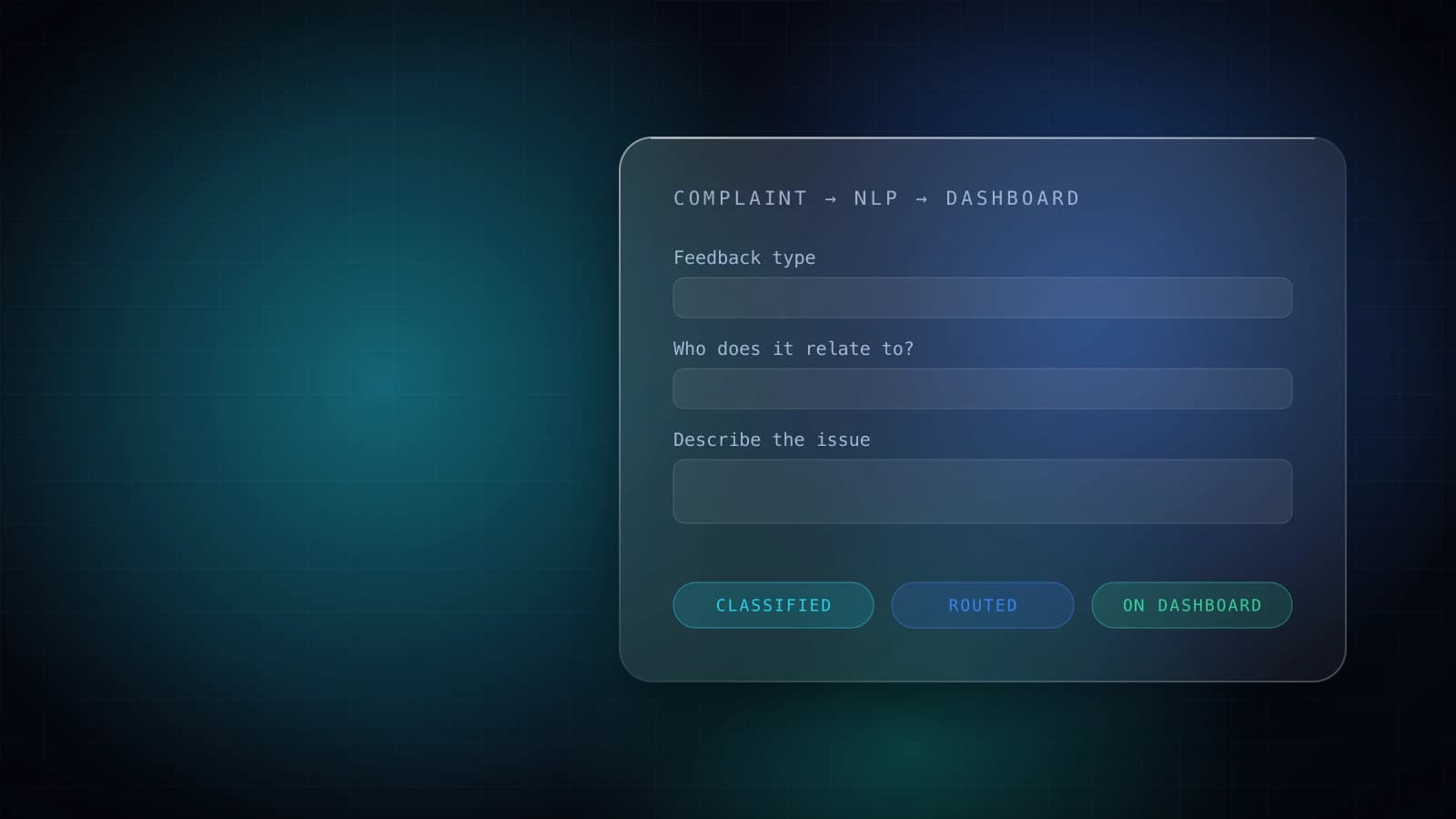
- Digital forms: CQC-standard web forms for feedback, complaint investigations, and spot checks, replacing the paper versions. Each submission gets a unique ID and is categorised as a complaint, compliment, or suggestion.
- Database: submissions are stored in a MySQL database, with a separate store for internal forms and digitised historical records.
- NLP classification: Python (NLTK and spaCy) classifies complaints by type and tracks keyword frequency to surface the most common issues.
- Dashboard: a Chart.js dashboard shows complaint investigations, spot checks, feedback volumes, and sentiment in real time.
- API integration: the system connects through APIs to PBL Care's scheduling and planning application, feeding a single database and a unified dashboard.
- Data validation: a lightweight Python/Node.js GUI tool checks data validity and integrity. It was later merged into PHP for the API integration.
Research findings
Outcome
- the feasibility study and market research
- a working proof of concept with CQC-standard forms, a database, NLP classification, and a live dashboard
- an assessment of whether the system could become an off-the-shelf SaaS product for other care providers